


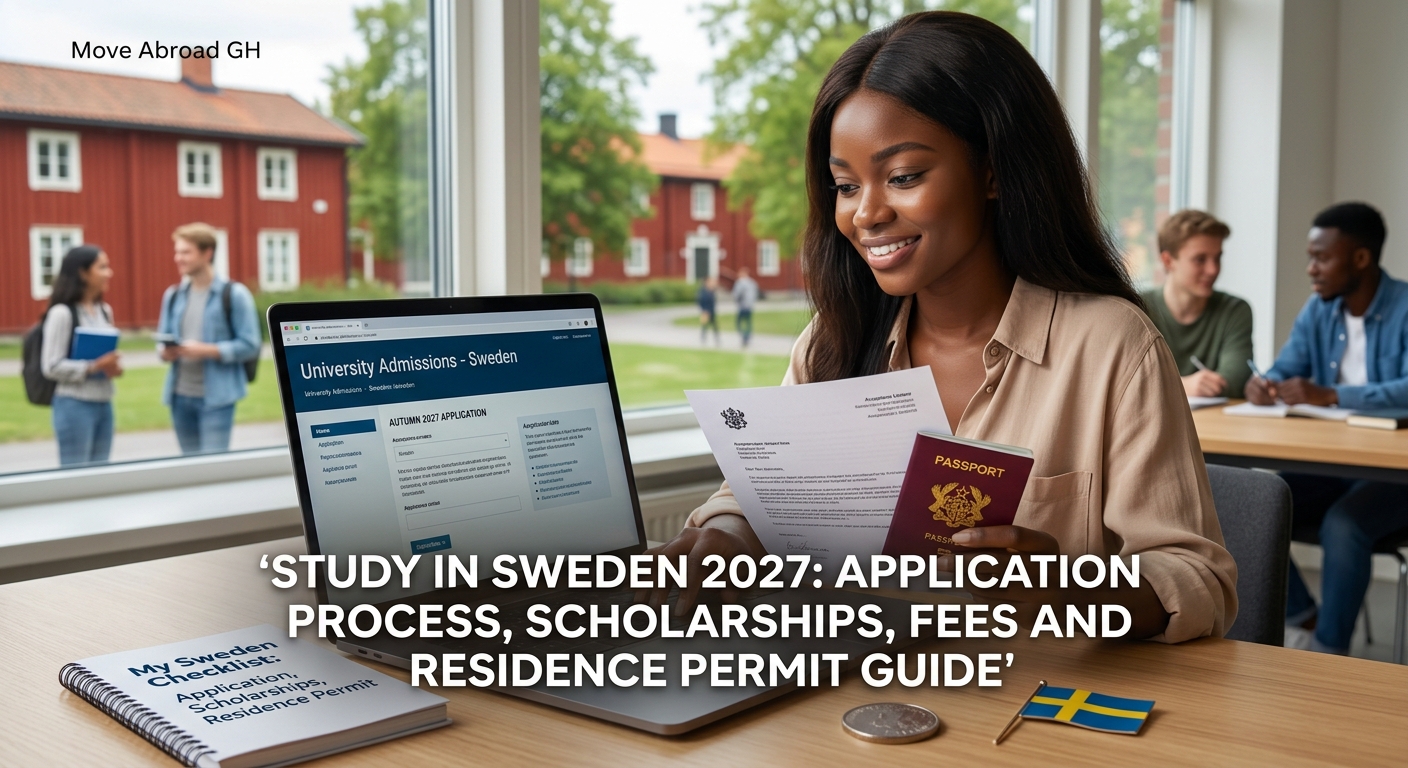
Sweden is a popular destination for international students because of its high-quality universities, English-taught programmes, research environment and strong focus on sustainability. If you plan to begin undergraduate, master’s or doctoral studies in Sweden in 2027, you should start preparing early because admission, scholarships and residence permits follow separate processes.
For international students applying for the autumn 2027 semester, the main First admissions round opens on 16 October 2026 and closes on 15 January 2027. Supporting documents and the application fee, where applicable, are due by 1 February 2027.universityadmissions
Why Study in Sweden?
Swedish universities offer many degree programmes taught in English, particularly at master’s level. Students benefit from a strong academic system, modern research facilities and close links between universities, industry and public institutions.
Sweden is especially attractive for students interested in areas such as engineering, technology, sustainability, public health, business, design, social sciences and environmental studies. However, admission is competitive, and applicants must meet both university entry requirements and immigration requirements.
Study Levels Available
Undergraduate Studies
International students can apply for bachelor’s programmes taught in English, although the number of English-taught undergraduate options is smaller than at master’s level. Applicants usually need upper-secondary education equivalent to Swedish entry requirements, as well as proof of English proficiency.
Bachelor’s programmes normally take three years of full-time study. Students apply through the national portal, University Admissions, and should apply in the First admissions round to allow enough time for residence-permit processing.
Master’s Studies
Master’s programmes are the most common route for international students in Sweden. Many are taught entirely in English and last one or two years. Applicants generally need a relevant bachelor’s degree, English-language evidence and programme-specific requirements such as a CV, motivation letter, portfolio or work experience.
Master’s applicants should pay particular attention to the Swedish Institute Scholarship for Global Professionals, a competitive fully funded scholarship for eligible international students.
PhD Studies
Doctoral positions in Sweden are often advertised as paid employment by universities rather than as traditional scholarships. PhD applicants normally need a relevant master’s degree, a strong research proposal or research fit, and sometimes direct contact with a prospective supervisor.
PhD students admitted to full-time doctoral studies may apply for a residence permit for doctoral studies. They must also meet health insurance and financial-maintenance requirements where applicable.
How to Apply to Swedish Universities
All international applicants apply through University Admissions, the national application portal for Swedish higher education. The portal allows students to search for English-taught courses and programmes, create an account, select and rank programmes, upload documents and track their application.universityadmissions
Step 1: Choose Your Programme
Search for eligible programmes on University Admissions and check each university’s official programme page. Confirm:
The degree level and duration
Language of instruction
Academic entry requirements
English-language requirements
Tuition-fee status
Application documents
Scholarship eligibility
Rank your selected programmes carefully, because your ranking can affect the admission result.
Step 2: Submit Your Application
For autumn 2027 entry, the First admissions round opens on 16 October 2026. The application deadline and final day to rank courses is 15 January 2027.
International students are encouraged to apply in this round because it gives non-EU/EEA students enough time to pay tuition fees, apply for a residence permit and arrange accommodation before the semester begins.
Step 3: Submit Supporting Documents
Applicants must provide documentation of previous studies and proof of English skills. Depending on the programme, universities may also require a CV, motivation letter, references, portfolio or proof of work experience.
For the autumn 2027 First admissions round, supporting documents must be submitted by 1 February 2027. The same deadline applies to the application fee and documentation of fee-exempt status, where relevant.
Step 4: Pay the Application Fee
Applicants from outside the EU/EEA and Switzerland generally pay an application fee when applying to Swedish universities. The fee must be paid by 1 February 2027 for the autumn 2027 First admissions round.
Students who qualify for an exemption must submit evidence of their fee-exempt status by the same date.
Step 5: Receive Your Admission Result
For autumn 2027, admission results are expected on 1 April 2027 for master’s programmes and 8 April 2027 for bachelor’s programmes. After receiving an offer, follow the university’s instructions, pay tuition fees if required and begin the residence-permit process as early as possible.
Tuition Fees in Sweden
Students from EU/EEA countries and Switzerland generally do not pay tuition fees at Swedish public universities. Students from other countries are usually required to pay tuition fees, which vary by university and programme.
In addition to tuition, students should budget for:
Application fees
Residence-permit fees
Accommodation and food
Health insurance, where required
Books and study materials
Transport and personal expenses
Scholarships may cover tuition and living costs, but not every scholarship covers every expense. Always check what is included before accepting an offer.
Scholarship Options for International Students
Swedish Institute Scholarship for Global Professionals
The Swedish Institute Scholarship for Global Professionals (SISGP) is a major fully funded scholarship for full-time, one- or two-year master’s studies in Sweden. It supports eligible students beginning master’s programmes in the autumn semester.si
The scholarship includes:
Full tuition-fee coverage, paid directly to the Swedish university
A monthly living allowance of SEK 12,000
A one-time travel grant of SEK 15,000 for most eligible countries, or SEK 10,000 for students from Armenia, Azerbaijan, Belarus, Georgia, Moldova and Ukraine
Membership in the SI Network for Global Professionals
Access to the Sweden Alumni Network after the scholarship period
The scholarship does not cover the University Admissions application fee, insurance, family members’ costs or changes to the awarded programme.
Who Can Apply for SISGP?
Applicants must be citizens of one of the eligible countries, apply for an eligible English-taught master’s programme, be liable for tuition fees and have demonstrated work and leadership experience. Eligible countries include Bangladesh, Brazil, Egypt, Ethiopia, Indonesia, Kenya, Nigeria, Pakistan is not listed, the Philippines, Rwanda, South Africa, Tanzania, Uganda, Ukraine, Vietnam and Zambia, among others.si
Applicants must also be admitted, or conditionally admitted, to an eligible master’s programme on the day admissions results are announced. A place on the reserve list does not qualify for the scholarship.
University Scholarships
Some Swedish universities offer their own scholarships for fee-paying international students, especially master’s applicants. These awards are competitive and may cover full or partial tuition fees.
University scholarships may have separate application procedures and deadlines, so applicants should check both the University Admissions portal and the official website of each Swedish university.
Scholarships for Bachelor’s and PhD Students
The Swedish Institute scholarships highlighted through University Admissions are available for eligible international master’s students beginning in the autumn semester; they are not available for bachelor’s studies or programmes beginning in spring.
PhD students should search for advertised doctoral positions directly on Swedish university websites. Many doctoral positions include a salary, but applicants must still meet the immigration and insurance requirements relevant to their situation.
Sweden Student Residence Permit
Non-EU/EEA students who are admitted to full-time studies in Sweden generally need a residence permit for studies. The permit cannot be granted for distance learning, and students must be finally admitted to full-time studies.
For university and university-college studies, 30 credits per semester counts as full-time study.
Financial Maintenance Requirement
Applicants must show sufficient financial maintenance for the entire period for which they are applying. For applications made in 2026, the requirement is at least SEK 10,656 per month. This amount may change for later application years, so students should verify the current figure on the Swedish Migration Agency website before applying.
Health Insurance
Students whose studies will last less than one year must have comprehensive health insurance. If insurance is not provided through the higher-education institution, students must have or have applied for their own insurance covering emergency and other medical care, hospitalisation and emergency dental care.
New Rules from June 2026
New rules for residence permits for first- and second-cycle studies came into force on 11 June 2026. Students must now make acceptable academic progress, with at least 37.5 credits during the first year and 45 credits per year from the second year onwards. Students must also notify the Swedish Migration Agency of their address within 30 days.
Important Dates for Autumn 2027
| Date | Event |
|---|---|
| 16 October 2026 | First admissions round opens |
| 15 January 2027 | Application deadline and last day to rank programmes |
| 1 February 2027 | Deadline for application fee, fee-exemption documents and supporting documents |
| 1 April 2027 | Master’s admission results published |
| 8 April 2027 | Bachelor’s admission results published |
| August/September 2027 | Autumn semester begins |
These dates apply to the First admissions round, which is the recommended route for international applicants.
Practical Application Tips
Apply in the First admissions round, especially if you need a residence permit.
Check both University Admissions requirements and the individual university’s programme requirements.
Prepare certified or officially translated academic documents early.
Take an accepted English test in good time if you do not already have valid proof of English proficiency.
Apply for the Swedish Institute Scholarship only after confirming that your chosen master’s programme is eligible.
Keep evidence of work and leadership experience ready if applying for SISGP.
Apply for your residence permit immediately after receiving your admission decision.
Start searching for accommodation early, as housing can be difficult to find in major Swedish cities.
10. Frequently Asked Questions
Can international students study in Sweden in 2027?
Yes. International students can apply for English-taught undergraduate, master’s and doctoral programmes in Sweden. Most bachelor’s and master’s applicants apply through University Admissions, while PhD applicants usually apply directly for advertised doctoral positions.migrationsverket+1
What is the application deadline for autumn 2027?
The First admissions round opens on 16 October 2026 and closes on 15 January 2027. Supporting documents, the application fee and fee-exemption evidence are due by 1 February 2027.
Are there scholarships for undergraduate students in Sweden?
Swedish Institute scholarships promoted through University Admissions are for eligible master’s students, not bachelor’s students. Bachelor’s applicants should look for university-specific awards, external scholarships or other funding options, although availability is limited.
What does the Swedish Institute Scholarship cover?
The Swedish Institute Scholarship for Global Professionals covers full tuition fees, provides a monthly allowance of SEK 12,000 and includes a one-time travel grant of SEK 15,000 for most eligible countries. It does not cover the University Admissions application fee, insurance or dependants’ costs.
Who is eligible for the Swedish Institute Scholarship?
Applicants must be citizens of eligible countries, apply for an eligible English-taught master’s programme, be liable for tuition fees and demonstrate work and leadership experience. They must also be admitted to an eligible programme when admissions results are announced.
Do I need IELTS to study in Sweden?
Many English-taught programmes require proof of English proficiency, and IELTS is commonly accepted. However, requirements vary by university and programme, so check the exact test and minimum score on the official programme page before applying.
How much money do I need for a Swedish student residence permit?
For applications made in 2026, applicants must show maintenance funds of at least SEK 10,656 per month for the period covered by the permit. Verify the current requirement before submitting your application because amounts can change.
Do EU students need a residence permit to study in Sweden?
EU/EEA citizens generally do not need a residence permit to study in Sweden, but they may need to register their right of residence depending on the length of their stay. Non-EU/EEA students normally need a residence permit for full-time studies.
Can I get a scholarship for a PhD in Sweden?
Many PhD positions in Sweden are funded as salaried employment rather than through a separate scholarship. Applicants should search university career and doctoral vacancy pages and contact potential supervisors or departments directly.
When do Swedish universities start in 2027?
Most autumn-semester programmes begin in August or September 2027. The exact start date depends on the university and programme.
Studying in Sweden in 2027 is possible at undergraduate, master’s and PhD level, but success depends on careful planning. International applicants should apply through University Admissions by 15 January 2027, submit all documents by 1 February 2027, and explore scholarships such as the Swedish Institute Scholarship for Global Professionals.







Leave a comment