


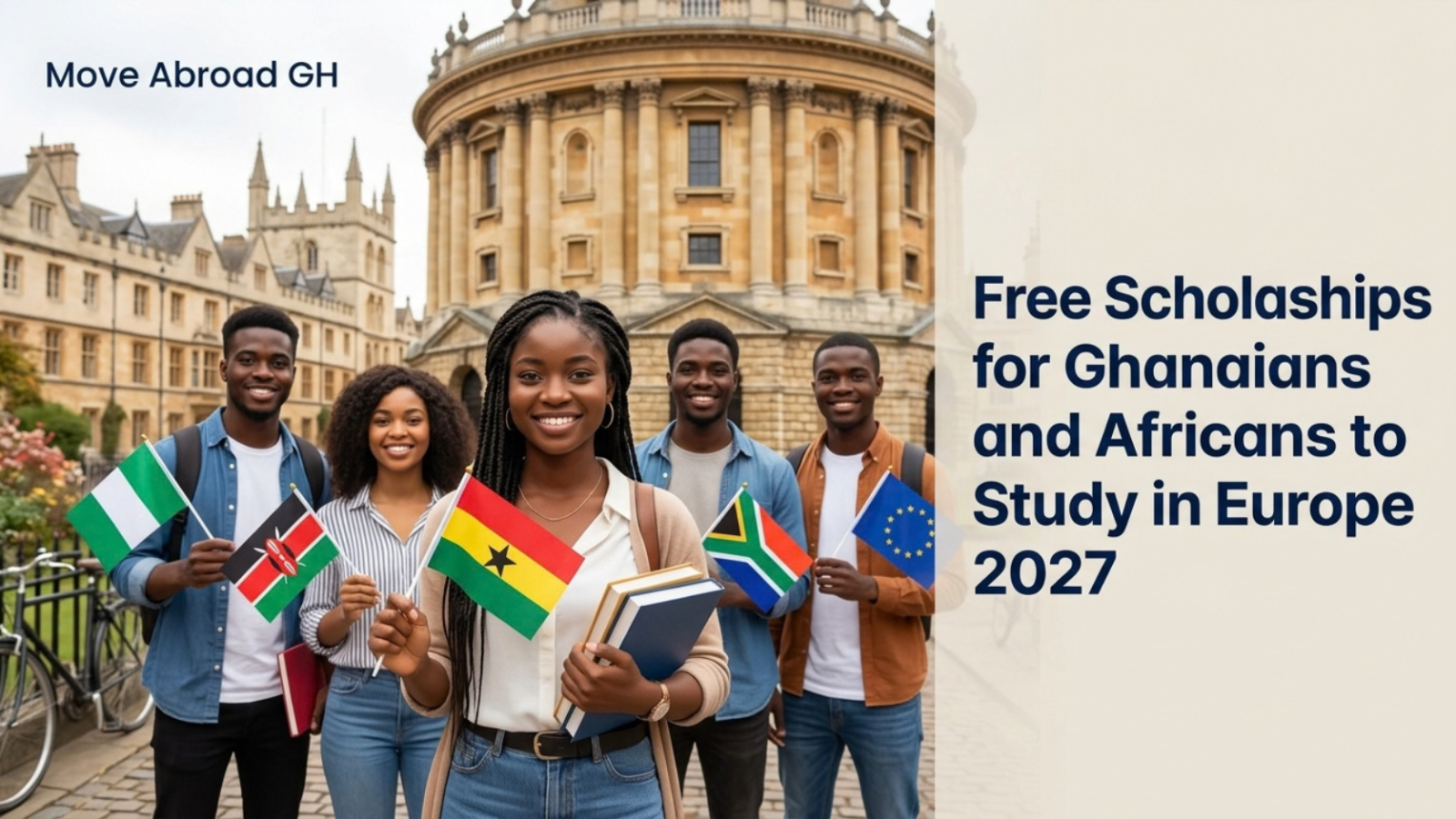
Ghanaian and other African students can access several scholarship opportunities connected to European universities and institutions. However, “free scholarship” does not always mean that every expense is covered. Some programmes provide full funding, while others cover tuition and provide allowances but require students to meet specific eligibility, academic and application conditions.
The most reliable opportunities identified from official sources include Erasmus Mundus Joint Masters, DAAD In-Country/In-Region scholarships, the Stipendium Hungaricum Scholarship for Ghanaian students, and selected country- or programme-specific scholarships. Applicants should always confirm the current call, eligible programmes and deadlines on the official website before applying.
1. Erasmus Mundus Joint Masters
The Erasmus Mundus Joint Masters programme is one of the strongest European scholarship options for students from Ghana and other countries worldwide. Students study at several universities in Europe and, in some cases, at partner institutions outside Europe.
The European Commission states that full scholarships are available for the best-ranked students worldwide. These scholarships cover participation costs and contribute towards travel, visa expenses and a living allowance. erasmus-plus.ec.europa
Key features
- Open to students from all over the world.
- Designed for master’s-level study.
- Programmes usually last one to two academic years.
- Students study at several universities in different countries.
- Programmes involve at least three higher-education institutions from at least three countries.
- Full scholarships are available for the strongest applicants.
- Scholarships contribute towards participation costs, travel, visa expenses and living costs.
Who can apply?
Applicants must generally:
- Hold a bachelor’s degree.
- Be in the final year of a bachelor’s programme and graduate before the master’s course starts.
- Meet the academic, language and subject-specific requirements of the selected programme.
Each Erasmus Mundus master’s programme establishes its own admission criteria, required documents and scholarship application process. Applicants therefore need to read the individual programme website rather than relying only on general Erasmus information.
Application period
In most cases, applications are submitted between October and January for courses beginning during the following academic year. The exact deadline differs from one master’s programme to another.
The European Commission also announced that 37 new Erasmus Mundus Joint Masters selected in 2026 would be added to the catalogue and begin opening student applications in autumn 2026 for programmes starting in September 2027.
How to apply
- Visit the official Erasmus Mundus catalogue.
- Search for programmes matching your academic background.
- Visit the selected master’s official website.
- Check the entry requirements and scholarship conditions.
- Prepare your transcript, degree certificate, CV, references and language documents.
- Submit the application directly to the institution or consortium running the programme.
There is no single application form covering every Erasmus Mundus master’s programme.
2. DAAD In-Country/In-Region Scholarships
The DAAD In-Country/In-Region Scholarship Programme supports postgraduate education and doctoral training in developing regions, with a particular focus on Sub-Saharan Africa.
Unlike scholarships that require students to travel to Germany, this programme generally supports study in the applicant’s home country or elsewhere within the applicant’s region. It is therefore an important opportunity for African students who want internationally supported postgraduate education while remaining in Africa.daad
What the programme supports
The programme supports:
- Consecutive master’s degrees.
- PhD programmes.
- Development-related fields.
- Future university teachers.
- Professionals and managers who can contribute to sustainable development.
- Academic teaching and research capacity in developing countries.
Funding may include
Depending on the specific programme and location, the scholarship usually includes:
- Tuition fees.
- A monthly scholarship allowance.
- Study and research allowances.
- Printing support for a final thesis.
- Travel support for in-region scholarship holders.
- Health-insurance support, generally for in-region scholars.
- Possible additional academic or research support.
Funding details vary by programme, so applicants must read the specific call for applications.
Ghanaian eligibility
DAAD’s official information identifies open calls for master’s programmes for students from Sub-Saharan African countries. The DAAD scholarship database and programme fact sheets have also listed selected participating institutions and programmes in Ghana, Kenya, Malawi, Nigeria, Rwanda, South Africa, Tanzania and Uganda.
Ghanaian applicants should not assume that every DAAD programme is open to them. Eligibility depends on:
- The specific academic programme.
- The participating university.
- The applicant’s academic qualification.
- Professional or university affiliation requirements.
- The deadline stated in the individual call.
How to apply
- Visit the DAAD In-Country/In-Region programme page.
- Open the list of current Sub-Saharan African calls.
- Select a programme that matches your qualifications.
- Read the programme-specific application document.
- Apply through the institution or application system named in that call.
- Submit all required documents before the stated deadline.
DAAD specifically advises applicants to check its scholarship database and the relevant host institution for details.
3. Stipendium Hungaricum Scholarship for Ghanaian Students
The Stipendium Hungaricum Scholarship is a Hungarian government scholarship programme that has offered opportunities for Ghanaian students at undergraduate, master’s and doctoral levels.
The Ghana Scholarships Secretariat has published information on offers from the Hungarian government for Ghanaian citizens to study in Hungary. Previous official notices have included undergraduate, master’s and PhD opportunities and required Ghanaian applicants to apply through the Stipendium Hungaricum platform as well as follow instructions from Ghana’s national sending partner.
Study levels
Depending on the annual call, opportunities may be available for:
- Bachelor’s degrees.
- Master’s degrees.
- One-tier master’s degrees.
- Doctoral programmes.
- Non-degree or preparatory programmes in selected cases.
Possible benefits
The scholarship package may include:
- Tuition-free education.
- A monthly stipend.
- Accommodation support or a contribution towards accommodation.
- Medical insurance.
- Support for study-related costs.
The exact benefits and conditions are determined by the relevant annual call. Applicants should not treat the benefits from an earlier cycle as a guarantee for a future cycle.
Ghanaian applicants
Ghanaian applicants must follow both parts of the application process:
- Apply through the official Stipendium Hungaricum application platform.
- Complete any additional submission required by Ghana’s Scholarships Secretariat.
The Ghanaian national process may include document submission, screening or nomination requirements. Applicants should use the latest notice from the Ghana Scholarships Secretariat because local deadlines may differ from the international portal deadline.
Academic requirements
Requirements vary by study level and programme. Applicants may need:
- WASSCE or equivalent secondary-school results for undergraduate study.
- A bachelor’s degree for master’s study.
- A master’s degree for doctoral study.
- Academic transcripts.
- A valid passport or identity document.
- Proof of language ability where required.
- Medical documents at a later stage.
- Additional documents requested by the chosen university.
Applicants should select programmes that match their previous education and the field categories allowed for Ghana in the relevant call.
4. VLIR-UOS ICP Connect Scholarships in Belgium
The VLIR-UOS ICP Connect scholarships support selected international study programmes at Flemish universities and universities of applied sciences in Belgium.
The official VLIR-UOS information states that ICP Connect scholarships are available to applicants from 29 eligible countries in Africa, Asia and Latin America. The programmes are taught in English and are offered by one or more Flemish higher-education institutions.vliruos
Important eligibility limitation
Ghana is not included in the 29-country list published for the 2026–2027 ICP Connect call. The listed African countries included countries such as Benin, Burkina Faso, Burundi, Cameroon, the Democratic Republic of the Congo, Ethiopia, Guinea, Kenya, Madagascar, Mali, Mozambique, Niger, Senegal, South Africa, Tanzania, Uganda and Zimbabwe.iuc.qnu.edu
Therefore, Ghanaian applicants should not assume that they qualify for VLIR-UOS unless the official country list changes in the relevant future call.
This is an example of why applicants must check the official eligible-country list rather than applying based only on the fact that a scholarship is described as “for Africans.”
Funding
For eligible applicants, the scholarship is generally described as covering major study-related costs such as:
- Tuition.
- Travel.
- Insurance.
- Living expenses.
The 2027–2028 call and exact programme deadlines should be checked on the official VLIR-UOS website when published. The 2026–2027 call has closed, and programme-specific deadlines have varied.
5. Other Scholarships to Monitor
Ghanaian and African students should also monitor official opportunities from:
- National governments in European countries.
- European universities.
- Research councils.
- Development agencies.
- Erasmus+ programmes.
- University-specific doctoral funding schemes.
- African-European academic partnerships.
However, applicants should distinguish between:
- A full scholarship.
- A tuition waiver.
- A partial tuition reduction.
- A stipend-only award.
- A scholarship that covers tuition but not accommodation.
- A grant that applies only to research or exchange study.
A scholarship should not be advertised as fully funded unless the official call clearly explains what it covers.
Scholarship Comparison
| Scholarship | Study location | Study level | Main applicants | Main support |
|---|---|---|---|---|
| Erasmus Mundus Joint Masters | Several European countries and partner locations | Master’s | Students worldwide | Participation costs, travel, visa contribution and living allowance for selected scholars |
| DAAD In-Country/In-Region | Home country or another country in the region | Master’s and PhD | Students from developing regions, especially Sub-Saharan Africa | Tuition, monthly support, study/research allowances and other benefits depending on the call |
| Stipendium Hungaricum | Hungary | Bachelor’s, master’s and PhD, depending on call | Eligible applicants from partner countries, including Ghana in relevant calls | Tuition-free study, stipend, accommodation support and medical insurance, subject to the call |
| VLIR-UOS ICP Connect | Belgium | Selected international programmes | Applicants from 29 listed countries | Major study, travel, insurance and living costs, subject to eligibility |
| Jean Monnet Scholarship | EU member countries | Graduate or research level | Eligible applicants connected to Türkiye and listed beneficiary countries | Tuition, living support and a fixed allowance; not a general Ghanaian scholarship |
How Ghanaian Applicants Should Search
A reliable scholarship search should follow a structured process.
Step 1: Identify your study level
Decide whether you are seeking:
- Undergraduate funding.
- A master’s scholarship.
- PhD funding.
- Postdoctoral support.
- A short research grant.
- An exchange or mobility opportunity.
Many scholarships are limited to one level.
Step 2: Check country eligibility
Read the official country list. “African scholarship” does not automatically mean every African nationality qualifies.
Check whether the scholarship requires applicants to:
- Be Ghanaian citizens.
- Be resident in Ghana.
- Be employed in a specific sector.
- Be enrolled at a participating university.
- Have studied in a particular country.
- Return to Africa after completing the programme.
Step 3: Confirm the funding package
Check whether the scholarship covers:
- Full tuition.
- A monthly stipend.
- Accommodation.
- Health insurance.
- Airfare.
- Visa expenses.
- Research costs.
- Family support.
- The complete study period.
Avoid relying on social-media headlines that use “fully funded” without explaining the actual benefits.
Step 4: Check the official deadline
Deadlines may vary by:
- Programme.
- University.
- Country.
- Study level.
- National nomination process.
For Erasmus Mundus, each master’s programme sets its own deadline. For DAAD, the deadline appears in the individual programme call. For Stipendium Hungaricum, Ghanaian applicants may have both an international application deadline and a national submission deadline.
Step 5: Prepare documents early
Common documents include:
- Academic certificates.
- Transcripts.
- Curriculum vitae.
- Motivation letter.
- Recommendation letters.
- Passport.
- Proof of language proficiency.
- Research proposal for PhD applications.
- Employment or university letters where required.
Applicants should ensure that names, dates and academic information are consistent across all documents.
Common Mistakes to Avoid
- Applying to a programme that does not accept Ghanaian applicants.
- Assuming all scholarships advertised for Africa cover every African country.
- Confusing a tuition waiver with full funding.
- Missing a separate national nomination process.
- Applying after the official deadline.
- Using an old application form.
- Paying an agent for access to an official scholarship.
- Submitting a generic motivation letter.
- Choosing a course unrelated to your academic background.
- Trusting scholarship claims without checking the official website.
Recommended Official Sources
Applicants should begin with these official sources:
- Erasmus Mundus Joint Masters for European joint master’s programmes.
- DAAD In-Country/In-Region Programme for Sub-Saharan African postgraduate opportunities.
- Stipendium Hungaricum application information for Hungary-based scholarships.
- Ghana Scholarships Secretariat for Ghana-specific government notices.
- VLIR-UOS study scholarships for its current country and programme eligibility.
Final Takeaway
The most clearly documented options for Ghanaian and African applicants include Erasmus Mundus Joint Masters, DAAD In-Country/In-Region scholarships and Stipendium Hungaricum opportunities for Ghanaian students. Erasmus Mundus is particularly relevant for students seeking a master’s degree across several European countries, while DAAD’s programme focuses mainly on postgraduate training within Africa. Stipendium Hungaricum can provide Hungary-based study opportunities for eligible Ghanaian applicants, but applicants must follow both the international and Ghanaian application requirements.
Because scholarship calls, deadlines and eligible countries change, applicants should verify every detail on the official programme website before preparing or submitting an application.







Leave a comment